AI Image Generators

Explore the best AI Image Generators — independent reviews, comparisons, pricing and step-by-step how-to guides, curated by Aizhi.

  • Cloud-to-cloud integration

    Cloud-to-cloud integration

    Cloud-to-Cloud Integration ( C2I ) allows users to connect disparate cloud computing platforms. While Paas (Platform as a service) and Saas (Software as a service) continue to gain momentum, different vendors have different implementations for cloud computing, e.g. Database, REST, SOAP API. Another name for Cloud-to-Cloud Integration is Cloud-Surfing. See also Cloud-based integration

    Read more →
  • Bitcoin Satoshi Vision

    Bitcoin Satoshi Vision

    Bitcoin Satoshi Vision (BSV) is a cryptocurrency that is a hard fork of Bitcoin Cash. Bitcoin Satoshi Vision was created in November 2018 by a group of individuals led by Craig Steven Wright, who has claimed since 2015 to be Satoshi Nakamoto, the creator of the original bitcoin. == History == === 2018 split from Bitcoin Cash === On 15 November 2018, a hard fork chain split of Bitcoin Cash occurred between two rival factions called Bitcoin Cash and Bitcoin SV. On 15 November 2018 Bitcoin Cash traded at about $289, and Bitcoin SV traded at about $96.50, down from $425.01 on 14 November for the un-split Bitcoin Cash. The split originated from what was described as a "civil war" in two competing Bitcoin Cash camps. The first camp, supported by entrepreneur Roger Ver and Jihan Wu of Bitmain, promoted the software entitled Bitcoin ABC (short for Adjustable Blocksize Cap), which would maintain the block size at 32 MB. The second camp led by Craig Steven Wright and billionaire Calvin Ayre put forth a competing software version Bitcoin SV, short for "Bitcoin Satoshi Vision", which would increase the block size limit to 128 MB. === 2019 de-listing from Binance === In April 2019, an online feud broke out between those who supported the claims of Bitcoin SV supporter Craig Wright that he was Satoshi Nakamoto, and those who did not. The feud resulted in cryptocurrency exchange Binance de-listing Bitcoin SV from their platform, stating that: At Binance, we periodically review each digital asset we list to ensure that it continues to meet the high level of standard we expect. When a coin or token no longer meets this standard, or the industry changes, we conduct a more in-depth review and potentially delist it. We believe this best protects all of our users. When we conduct these reviews, we consider a variety of factors. Here are some that drive whether we decide to delist a digital asset: Commitment of team to project Level and quality of development activity Network / smart contract stability Level of public communication Responsiveness to our periodic due diligence requests Evidence of unethical / fraudulent conduct Contribution to a healthy and sustainable crypto ecosystem === 2021 network attack === In August 2021, Bitcoin SV suffered a 51% attack, after previously suffering attacks in June and July of the same year. Such an attack involves cryptocurrency miners gaining control of more than half of a network's computing power; these kinds of network attacks have the goal of preventing new transactions from gaining confirmations, allowing the attackers to double-spend coins. Adam James, senior editor at OKEx Insights claimed that "In the intermediate term, the attack has seemingly somewhat-negligible impact on its current price action," however "Faith in [Bitcoin SV] will likely be reduced following the incident." === 2024 high court ruling === In March 2024, Mr Justice James Mellor in the British High Court ruled that Wright is not Satoshi Nakamoto.

    Read more →
  • G.hn

    G.hn

    Gigabit Home Networking (G.hn) is a specification for wired home networking that supports speeds up to 2 Gbit/s and operates over four types of legacy wires: telephone wiring, coaxial cables, power lines and plastic optical fiber. Some benefits of a multi-wire standard are lower equipment development costs and lower deployment costs for service providers (by allowing customer self-install). == History == G.hn was developed under the International Telecommunication Union's Telecommunication Standardization sector (the ITU-T) and promoted by the HomeGrid Forum and several other organizations. ITU-T Recommendation (the ITU's term for standard) G.9960, which received approval on October 9, 2009, specified the physical layers and the architecture of G.hn. The Data Link Layer (Recommendation G.9961) was approved on June 11, 2010. Prominent organizations, including CEPca, HomePNA, and UPA, who were creators of some of these interfaces, rallied behind the latest version of the standard, emphasizing its potential and significance in the home networking domain. Moreover, the ITU-T extended the technology with multiple input, multiple output (MIMO) technology to increase data rates and signaling distance. This new feature was approved in March 2012 under G.9963 Recommendation. The development and promotion of G.hn have been significantly supported by the HomeGrid Forum and several other organizations. The technology was not only designed to address home-networking challenges but also found applications beyond this initial scope, showcasing its versatility and potential in the networking domain. == Technical specifications == === Technical overview === G.hn specifies a single physical layer based on fast Fourier transform (FFT) orthogonal frequency-division multiplexing (OFDM) modulation and low-density parity-check code (LDPC) forward error correction (FEC) code. G.hn includes the capability to notch specific frequency bands to avoid interference with amateur radio bands and other licensed radio services. G.hn includes mechanisms to avoid interference with legacy home networking technologies and also with other wireline systems such as VDSL2 or other types of DSL used to access the home. OFDM systems split the transmitted signal into multiple orthogonal sub-carriers. In G.hn each one of the sub-carriers is modulated using QAM. The maximum QAM constellation supported by G.hn is 4096-QAM (12-bit QAM). The G.hn media access control is based on a time division multiple access (TDMA) architecture, in which a "domain master" schedules Transmission Opportunities (TXOPs) that can be used by one or more devices in the "domain". There are two types of TXOPs: Contention-Free Transmission Opportunities (CFTXOP), which have a fixed duration and are allocated to a specific pair of transmitter and receiver. CFTXOP are used for implementing TDMA Channel Access for specific applications that require quality of service (QoS) guarantees. Shared Transmission Opportunities (STXOP), which are shared among multiple devices in the network. STXOP are divided into Time Slots (TS). There are two types of TS: Contention-Free Time Slots (CFTS), which are used for implementing "implicit" token passing Channel Access. In G.hn, a series of consecutive CFTS is allocated to a number of devices. The allocation is performed by the "domain master" and broadcast to all nodes in the network. There are pre-defined rules that specify which device can transmit after another device has finished using the channel. As all devices know "who is next", there is no need to explicitly send a "token" between devices. The process of "passing the token" is implicit and ensures that there are no collisions during Channel access. Contention-Based Time Slots (CBTS), which are used for implementing CSMA/CARP Channel Access. In general, CSMA systems cannot completely avoid collisions, so CBTS are only useful for applications that do not have strict Quality of Service requirements. ==== Optimization for each medium ==== Although most elements of G.hn are common for all three media supported by the standard (power lines, phone lines and coaxial cable), G.hn includes media-specific optimizations for each media. Some of these media-specific parameters include: OFDM Carrier Spacing: 195.31 kHz in coaxial, 48.82 kHz in phone lines, 24.41 kHz in power lines. FEC Rates: G.hn's FEC can operate with code rates 1/2, 2/3, 5/6, 16/18 and 20/21. Although these rates are not media specific, it is expected that the higher code rates will be used in cleaner media (such as coaxial) while the lower code rates will be used in noisy environments such as power lines. Automatic repeat request (ARQ) mechanisms: G.hn supports operation both with and without ARQ (re-transmission). Although this is not media specific, it is expected that ARQ-less operation is sometimes appropriate for cleaner media (such as coaxial) while ARQ operation is appropriate for noisy environments such as power lines. Power levels and frequency bands: G.hn defines different power masks for each medium. MIMO support: Recommendation G.9963 includes provisions for transmitting G.hn signals over multiple AC wires (phase, neutral, ground), if they are physically available. In July 2016, G.9963 was updated to include MIMO support over twisted pairs. ==== Security ==== G.hn uses the Advanced Encryption Standard (AES) encryption algorithm (with a 128-bit key length) using the CCMP protocol to ensure confidentiality and message integrity. Authentication and key exchange is done following ITU-T Recommendation X.1035. G.hn specifies point-to-point security inside a domain, which means that each pair of transmitter and receiver uses a unique encryption key which is not shared by other devices in the same domain. For example, if node Alice sends data to node Bob, node Eve (in the same domain as Alice and Bob) will not be able to easily eavesdrop their communication. G.hn supports the concept of relays, in which one device can receive a message from one node and deliver it to another node farther away in the same domain. Relaying becomes critical for applications with complex network topologies that need to cover large distances, such as those found in industrial or utility applications. While a relay can read the source and target addresses, it cannot read the message's content due to its body being end-to-end-encrypted. ==== Profiles ==== The G.hn architecture includes the concept of profiles. Profiles are intended to address G.hn nodes with significantly different levels of complexity. In G.hn the higher complexity profiles are proper supersets of lower complexity profiles, so that devices based on different profiles can interoperate with each other. Examples of G.hn devices based on high complexity profiles are Residential Gateways or Set-Top Boxes. Examples of G.hn devices based on low complexity profiles are home automation, home security and smart grid devices. ==== Technical parameters ==== The chart depicts a summary of the crucial technical specifications of the G.hn standard. Many of these technical elements are consistent across different physical media, with variations seen in areas such as Tone Spacing and frequency ranges. This uniformity is essential as it allows silicon manufacturers to produce a singular chip capable of implementing all three media types, leading to cost savings. Presently, G.hn chipsets are compatible with all three media types. This compatibility allows system manufacturers to create devices that can adjust to any wiring type simply by modifying a software configuration in the equipment. === Spectrum === The G.hn spectrum depends on the medium as shown in the diagram below: === Protocol stack === G.hn specifies the physical layer and the data link layer, according to the OSI model. The G.hn Data Link Layer (Recommendation G.9961) is divided into three sub-layers: The Application Protocol Convergence (APC) Layer, which accepts frames (usually in Ethernet format) from the upper layer (Application Entity) and encapsulates them into G.hn APC protocol data units (APDUs). The maximum payload of each APDU is 214 bytes. The logical link control (LLC), which is responsible for encryption, aggregation, segmentation and automatic repeat-request. This sub-layer is also responsible for "relaying" of APDUs between nodes that may not be able to communicate through a direct connection. The medium access control (MAC), which schedules channel access. The G.hn physical layer (Recommendation G.9960) is divided into three sub-layers: The Physical Coding Sub-layer (PCS), responsible for generating PHY headers. The Physical Medium Attachment (PMA), responsible for scrambling and forward error correction coding/decoding. The Physical Medium Dependent (PMD), responsible for bit-loading and OFDM modulation. The interface between the Application Entity and the Data Link Layer is called A-interface. The interface between the Data Link Layer and the ph

    Read more →
  • G.hn

    G.hn

    Gigabit Home Networking (G.hn) is a specification for wired home networking that supports speeds up to 2 Gbit/s and operates over four types of legacy wires: telephone wiring, coaxial cables, power lines and plastic optical fiber. Some benefits of a multi-wire standard are lower equipment development costs and lower deployment costs for service providers (by allowing customer self-install). == History == G.hn was developed under the International Telecommunication Union's Telecommunication Standardization sector (the ITU-T) and promoted by the HomeGrid Forum and several other organizations. ITU-T Recommendation (the ITU's term for standard) G.9960, which received approval on October 9, 2009, specified the physical layers and the architecture of G.hn. The Data Link Layer (Recommendation G.9961) was approved on June 11, 2010. Prominent organizations, including CEPca, HomePNA, and UPA, who were creators of some of these interfaces, rallied behind the latest version of the standard, emphasizing its potential and significance in the home networking domain. Moreover, the ITU-T extended the technology with multiple input, multiple output (MIMO) technology to increase data rates and signaling distance. This new feature was approved in March 2012 under G.9963 Recommendation. The development and promotion of G.hn have been significantly supported by the HomeGrid Forum and several other organizations. The technology was not only designed to address home-networking challenges but also found applications beyond this initial scope, showcasing its versatility and potential in the networking domain. == Technical specifications == === Technical overview === G.hn specifies a single physical layer based on fast Fourier transform (FFT) orthogonal frequency-division multiplexing (OFDM) modulation and low-density parity-check code (LDPC) forward error correction (FEC) code. G.hn includes the capability to notch specific frequency bands to avoid interference with amateur radio bands and other licensed radio services. G.hn includes mechanisms to avoid interference with legacy home networking technologies and also with other wireline systems such as VDSL2 or other types of DSL used to access the home. OFDM systems split the transmitted signal into multiple orthogonal sub-carriers. In G.hn each one of the sub-carriers is modulated using QAM. The maximum QAM constellation supported by G.hn is 4096-QAM (12-bit QAM). The G.hn media access control is based on a time division multiple access (TDMA) architecture, in which a "domain master" schedules Transmission Opportunities (TXOPs) that can be used by one or more devices in the "domain". There are two types of TXOPs: Contention-Free Transmission Opportunities (CFTXOP), which have a fixed duration and are allocated to a specific pair of transmitter and receiver. CFTXOP are used for implementing TDMA Channel Access for specific applications that require quality of service (QoS) guarantees. Shared Transmission Opportunities (STXOP), which are shared among multiple devices in the network. STXOP are divided into Time Slots (TS). There are two types of TS: Contention-Free Time Slots (CFTS), which are used for implementing "implicit" token passing Channel Access. In G.hn, a series of consecutive CFTS is allocated to a number of devices. The allocation is performed by the "domain master" and broadcast to all nodes in the network. There are pre-defined rules that specify which device can transmit after another device has finished using the channel. As all devices know "who is next", there is no need to explicitly send a "token" between devices. The process of "passing the token" is implicit and ensures that there are no collisions during Channel access. Contention-Based Time Slots (CBTS), which are used for implementing CSMA/CARP Channel Access. In general, CSMA systems cannot completely avoid collisions, so CBTS are only useful for applications that do not have strict Quality of Service requirements. ==== Optimization for each medium ==== Although most elements of G.hn are common for all three media supported by the standard (power lines, phone lines and coaxial cable), G.hn includes media-specific optimizations for each media. Some of these media-specific parameters include: OFDM Carrier Spacing: 195.31 kHz in coaxial, 48.82 kHz in phone lines, 24.41 kHz in power lines. FEC Rates: G.hn's FEC can operate with code rates 1/2, 2/3, 5/6, 16/18 and 20/21. Although these rates are not media specific, it is expected that the higher code rates will be used in cleaner media (such as coaxial) while the lower code rates will be used in noisy environments such as power lines. Automatic repeat request (ARQ) mechanisms: G.hn supports operation both with and without ARQ (re-transmission). Although this is not media specific, it is expected that ARQ-less operation is sometimes appropriate for cleaner media (such as coaxial) while ARQ operation is appropriate for noisy environments such as power lines. Power levels and frequency bands: G.hn defines different power masks for each medium. MIMO support: Recommendation G.9963 includes provisions for transmitting G.hn signals over multiple AC wires (phase, neutral, ground), if they are physically available. In July 2016, G.9963 was updated to include MIMO support over twisted pairs. ==== Security ==== G.hn uses the Advanced Encryption Standard (AES) encryption algorithm (with a 128-bit key length) using the CCMP protocol to ensure confidentiality and message integrity. Authentication and key exchange is done following ITU-T Recommendation X.1035. G.hn specifies point-to-point security inside a domain, which means that each pair of transmitter and receiver uses a unique encryption key which is not shared by other devices in the same domain. For example, if node Alice sends data to node Bob, node Eve (in the same domain as Alice and Bob) will not be able to easily eavesdrop their communication. G.hn supports the concept of relays, in which one device can receive a message from one node and deliver it to another node farther away in the same domain. Relaying becomes critical for applications with complex network topologies that need to cover large distances, such as those found in industrial or utility applications. While a relay can read the source and target addresses, it cannot read the message's content due to its body being end-to-end-encrypted. ==== Profiles ==== The G.hn architecture includes the concept of profiles. Profiles are intended to address G.hn nodes with significantly different levels of complexity. In G.hn the higher complexity profiles are proper supersets of lower complexity profiles, so that devices based on different profiles can interoperate with each other. Examples of G.hn devices based on high complexity profiles are Residential Gateways or Set-Top Boxes. Examples of G.hn devices based on low complexity profiles are home automation, home security and smart grid devices. ==== Technical parameters ==== The chart depicts a summary of the crucial technical specifications of the G.hn standard. Many of these technical elements are consistent across different physical media, with variations seen in areas such as Tone Spacing and frequency ranges. This uniformity is essential as it allows silicon manufacturers to produce a singular chip capable of implementing all three media types, leading to cost savings. Presently, G.hn chipsets are compatible with all three media types. This compatibility allows system manufacturers to create devices that can adjust to any wiring type simply by modifying a software configuration in the equipment. === Spectrum === The G.hn spectrum depends on the medium as shown in the diagram below: === Protocol stack === G.hn specifies the physical layer and the data link layer, according to the OSI model. The G.hn Data Link Layer (Recommendation G.9961) is divided into three sub-layers: The Application Protocol Convergence (APC) Layer, which accepts frames (usually in Ethernet format) from the upper layer (Application Entity) and encapsulates them into G.hn APC protocol data units (APDUs). The maximum payload of each APDU is 214 bytes. The logical link control (LLC), which is responsible for encryption, aggregation, segmentation and automatic repeat-request. This sub-layer is also responsible for "relaying" of APDUs between nodes that may not be able to communicate through a direct connection. The medium access control (MAC), which schedules channel access. The G.hn physical layer (Recommendation G.9960) is divided into three sub-layers: The Physical Coding Sub-layer (PCS), responsible for generating PHY headers. The Physical Medium Attachment (PMA), responsible for scrambling and forward error correction coding/decoding. The Physical Medium Dependent (PMD), responsible for bit-loading and OFDM modulation. The interface between the Application Entity and the Data Link Layer is called A-interface. The interface between the Data Link Layer and the ph

    Read more →
  • Halite AI Programming Competition

    Halite AI Programming Competition

    Halite is an open-source computer programming contest developed by the hedge fund/tech firm Two Sigma in partnership with a team at Cornell Tech. Programmers can see the game environment and learn everything they need to know about the game. Participants are asked to build bots in whichever language they choose to compete on a two-dimensional virtual battle field. == History == Benjamin Spector and Michael Truell created the first Halite competition in 2016, before partnering with Two Sigma later that year. === Halite I === Halite I asked participants to conquer territory on a grid. It launched in November 2016 and ended in February 2017. Halite I attracted about 1,500 players. === Halite II === Halite II was similar to Halite I, but with a space-war theme. It ran from October 2017 until January 2018. The second installment of the competition attracted about 6,000 individual players from more than 100 countries. Among the participants were professors, physicists and NASA engineers, as well as high school and university students. === Halite III === Halite III launched in mid-October 2018. It ran from October 2018 to January 2019, with an ocean themed playing field. Players were asked to collect and manage Halite, an energy resource. By the end of the competition, Halite III included more than 4000 players and 460 organizations. === Halite IV === Halite IV was hosted by Kaggle, and launched in mid-June 2020.

    Read more →
  • Kruskal count

    Kruskal count

    The Kruskal count (also known as Kruskal's principle, Dynkin–Kruskal count, Dynkin's counting trick, Dynkin's card trick, coupling card trick or shift coupling) is a probabilistic concept originally demonstrated by the Russian mathematician Evgenii Borisovich Dynkin in the 1950s or 1960s discussing coupling effects and rediscovered as a card trick by the American mathematician Martin David Kruskal in the early 1970s as a side-product while working on another problem. It was published by Kruskal's friend Martin Gardner and magician Karl Fulves in 1975. This is related to a similar trick published by magician Alexander F. Kraus in 1957 as Sum total and later called Kraus principle. Besides uses as a card trick, the underlying phenomenon has applications in cryptography, code breaking, software tamper protection, code self-synchronization, control-flow resynchronization, design of variable-length codes and variable-length instruction sets, web navigation, object alignment, and others. == Card trick == The trick is performed with cards, but is more a magical-looking effect than a conventional magic trick. The magician has no access to the cards, which are manipulated by members of the audience. Thus sleight of hand is not possible. Rather the effect is based on the mathematical fact that the output of a Markov chain, under certain conditions, is typically independent of the input. A simplified version using the hands of a clock performed by David Copperfield is as follows. A volunteer picks a number from one to twelve and does not reveal it to the magician. The volunteer is instructed to start from 12 on the clock and move clockwise by a number of spaces equal to the number of letters that the chosen number has when spelled out. This is then repeated, moving by the number of letters in the new number. The output after three or more moves does not depend on the initially chosen number and therefore the magician can predict it.

    Read more →
  • Cambridge Semantics

    Cambridge Semantics

    Cambridge Semantics is a privately held company headquartered in Boston, Massachusetts with an office in San Diego, California. The company is an enterprise big data management and exploratory analytics software company. == History == Cambridge Semantics was founded in 2007 by Sean Martin, Lee Feigenbaum, Simon Martin, Rouben Meschian, Ben Szekely and Emmett Eldred who all previously worked at IBM's Advanced Technology Internet Group. In 2012, Cambridge Semantics appointed Chuck Pieper as chief executive. Pieper was previously at Credit Suisse. In January 2016, Cambridge Semantics acquired SPARQL City and its graph database intellectual property. On April 18, 2024, Altair Engineering acquired Cambridge Semantics. On 26 March 2025, Siemens announced the acquisition of Altair. == Products == Anzo Smart Data Lake uses Semantic Web Technologies. It allows IT departments and their business users to access data. AnzoGraph DB Graph database. AnzoGraph DB is a massively parallel processing (MPP) native graph database built for diverse data harmonization and analytics at scale (trillions of triples and more), speed and deep link insights. It is used for embedded analytics that require graph algorithms, graph views, named queries, aggregates, geospatial, built-in data science functions, data warehouse-style BI and reporting functions. It allows users to load and query RDF data using SPARQL or Cypher for OLAP-style analytics. == Marketing == Cambridge Semantics named SIIA Codie award 2018 finalist. Cambridge Semantics named 2018 Gold Stevie Award Winner for 'Big Data Solutions'. Cambridge Semantics named KMWorld’s 2018 ‘100 Companies That Matter in Knowledge Management’. Cambridge Semantics named to Database Trends and Applications' 'Trend-Setting Products in Data and Information Management for 2018'. Cambridge Semantics named to KMWorld Trend-Setting Products of 2017. Cambridge Semantics named to Database Trends and Applications 'DBTA 100: The Companies That Matter Most in Data'. Cambridge Semantics named SIIA Codie award 2017 winner for ‘Best Text Analytics and Semantic Technology Solution’. Cambridge Semantics named 2017 Silver Stevie Award Winner for 'Big Data Solutions'. Cambridge Semantics named KMWorld’s 2017 ‘100 Companies That Matter in Knowledge Management’. Cambridge Semantics named SIIA Codie award 2016 finalist. Cambridge Semantics named KMWorld’s 2016 ‘100 Companies That Matter in Knowledge Management’ and KMWorld Trend-Setting Products of 2015. Cambridge Semantics named 2016 Bio-IT World Best of Show People's Choice Award Contenders and 2015 Bio-IT best of show finalist. Anzo Insider Trading Investigation and Surveillance named 2015 CODiE Award finalist. Cambridge Semantics Selected as Finalist for 2014 MIT Sloan CIO Symposium's Innovation Showcase. Cambridge Semantics named SIIA CODiE Award 2014 finalist. Cambridge Semantics Win 2013 SIIA CODiE Award for best business intelligence and analytics solution. Cambridge Semantics wins KMWorld 2012 Promise Award. Cambridge Semantics wins Best of Show at 2012 Bio-IT World Conference.

    Read more →
  • Branch number

    Branch number

    In cryptography, the branch number is a numerical value that characterizes the amount of diffusion introduced by a vectorial Boolean function F that maps an input vector a to output vector F ( a ) {\displaystyle F(a)} . For the (usual) case of a linear F the value of the differential branch number is produced by: applying nonzero values of a (i.e., values that have at least one non-zero component of the vector) to the input of F; calculating for each input value a the Hamming weight W {\displaystyle W} (number of nonzero components), and adding weights W ( a ) {\displaystyle W(a)} and W ( F ( a ) ) {\displaystyle W(F(a))} together; selecting the smallest combined weight across for all nonzero input values: B d ( F ) = min a ≠ 0 ( W ( a ) + W ( F ( a ) ) ) {\displaystyle B_{d}(F)={\underset {a\neq 0}{\min }}(W(a)+W(F(a)))} . If both a and F ( a ) {\displaystyle F(a)} have s components, the result is obviously limited on the high side by the value s + 1 {\displaystyle s+1} (this "perfect" result is achieved when any single nonzero component in a makes all components of F ( a ) {\displaystyle F(a)} to be non-zero). A high branch number suggests higher resistance to the differential cryptanalysis: the small variations of input will produce large changes on the output and in order to obtain small variations of the output, large changes of the input value will be required. The term was introduced by Daemen and Rijmen in early 2000s and quickly became a typical tool to assess the diffusion properties of the transformations. == Mathematics == The branch number concept is not limited to the linear transformations, Daemen and Rijmen provided two general metrics: differential branch number, where the minimum is obtained over inputs of F that are constructed by independently sweeping all the values of two nonzero and unequal vectors a, b ( ⊕ {\displaystyle \oplus } is a component-by-component exclusive-or): B d ( F ) = min a ≠ b ( W ( a ⊕ b ) + W ( F ( a ) ⊕ F ( b ) ) {\displaystyle B_{d}(F)={\underset {a\neq b}{\min }}(W(a\oplus b)+W(F(a)\oplus F(b))} ; for linear branch number, the independent candidates α {\displaystyle \alpha } and β {\displaystyle \beta } are independently swept; they should be nonzero and correlated with respect to F (the L A T ( α , β ) {\displaystyle LAT(\alpha ,\beta )} coefficient of the linear approximation table of F should be nonzero): B l ( F ) = min α ≠ 0 , β , L A T ( α , β ) ≠ 0 ( W ( α ) + W ( β ) ) {\displaystyle B_{l}(F)={\underset {\alpha \neq 0,\beta ,LAT(\alpha ,\beta )\neq 0}{\min }}(W(\alpha )+W(\beta ))} .

    Read more →
  • Neurorobotics

    Neurorobotics

    Neurorobotics is the combined study of neuroscience, robotics, and artificial intelligence. It is the science and technology of embodied autonomous neural systems. Neural systems include brain-inspired algorithms (e.g. connectionist networks), computational models of biological neural networks (e.g. artificial spiking neural networks, large-scale simulations of neural microcircuits) and actual biological systems (e.g. in vivo and in vitro neural nets). Such neural systems can be embodied in machines with mechanic or any other forms of physical actuation. This includes robots, prosthetic or wearable systems but also, at smaller scale, micro-machines and, at the larger scales, furniture and infrastructures. Neurorobotics is that branch of neuroscience with robotics, which deals with the study and application of science and technology of embodied autonomous neural systems like brain-inspired algorithms. It is based on the idea that the brain is embodied and the body is embedded in the environment. Therefore, most neurorobots are required to function in the real world, as opposed to a simulated environment. Beyond brain-inspired algorithms for robots neurorobotics may also involve the design of brain-controlled robot systems. == Major classes of models == Neurorobots can be divided into various major classes based on the robot's purpose. Each class is designed to implement a specific mechanism of interest for study. Common types of neurorobots are those used to study motor control, memory, action selection, and perception. === Locomotion and motor control === Neurorobots are often used to study motor feedback and control systems, and have proved their merit in developing controllers for robots. Locomotion is modeled by a number of neurologically inspired theories on the action of motor systems. Locomotion control has been mimicked using models or central pattern generators, clumps of neurons capable of driving repetitive behavior, to make four-legged walking robots. Other groups have expanded the idea of combining rudimentary control systems into a hierarchical set of simple autonomous systems. These systems can formulate complex movements from a combination of these rudimentary subsets. This theory of motor action is based on the organization of cortical columns, which progressively integrate from simple sensory input into a complex afferent signals, or from complex motor programs to simple controls for each muscle fiber in efferent signals, forming a similar hierarchical structure. Another method for motor control uses learned error correction and predictive controls to form a sort of simulated muscle memory. In this model, awkward, random, and error-prone movements are corrected for using error feedback to produce smooth and accurate movements over time. The controller learns to create the correct control signal by predicting the error. Using these ideas, robots have been designed which can learn to produce adaptive arm movements or to avoid obstacles in a course. === Learning and memory systems === Robots designed to test theories of animal memory systems. Many studies examine the memory system of rats, particularly the rat hippocampus, dealing with place cells, which fire for a specific location that has been learned. Systems modeled after the rat hippocampus are generally able to learn mental maps of the environment, including recognizing landmarks and associating behaviors with them, allowing them to predict the upcoming obstacles and landmarks. Another study has produced a robot based on the proposed learning paradigm of barn owls for orientation and localization based on primarily auditory, but also visual stimuli. The hypothesized method involves synaptic plasticity and neuromodulation, a mostly chemical effect in which reward neurotransmitters such as dopamine or serotonin affect the firing sensitivity of a neuron to be sharper. The robot used in the study adequately matched the behavior of barn owls. Furthermore, the close interaction between motor output and auditory feedback proved to be vital in the learning process, supporting active sensing theories that are involved in many of the learning models. Neurorobots in these studies are presented with simple mazes or patterns to learn. Some of the problems presented to the neurorobot include recognition of symbols, colors, or other patterns and execute simple actions based on the pattern. In the case of the barn owl simulation, the robot had to determine its location and direction to navigate in its environment. === Action selection and value systems === Action selection studies deal with negative or positive weighting to an action and its outcome. Neurorobots can and have been used to study simple ethical interactions, such as the classical thought experiment where there are more people than a life raft can hold, and someone must leave the boat to save the rest. However, more neurorobots used in the study of action selection contend with much simpler persuasions such as self-preservation or perpetuation of the population of robots in the study. These neurorobots are modeled after the neuromodulation of synapses to encourage circuits with positive results. In biological systems, neurotransmitters such as dopamine or acetylcholine positively reinforce neural signals that are beneficial. One study of such interaction involved the robot Darwin VII, which used visual, auditory, and a simulated taste input to "eat" conductive metal blocks. The arbitrarily chosen good blocks had a striped pattern on them while the bad blocks had a circular shape on them. The taste sense was simulated by conductivity of the blocks. The robot had positive and negative feedbacks to the taste based on its level of conductivity. The researchers observed the robot to see how it learned its action selection behaviors based on the inputs it had. Other studies have used herds of small robots which feed on batteries strewn about the room, and communicate its findings to other robots. === Sensory perception === Neurorobots have also been used to study sensory perception, particularly vision. These are primarily systems that result from embedding neural models of sensory pathways in automatas. This approach gives exposure to the sensory signals that occur during behavior and also enables a more realistic assessment of the degree of robustness of the neural model. It is well known that changes in the sensory signals produced by motor activity provide useful perceptual cues that are used extensively by organisms. For example, researchers have used the depth information that emerges during replication of human head and eye movements to establish robust representations of the visual scene. == Biological robots == Biological robots are not officially neurorobots in that they are not neurologically inspired AI systems, but actual neuron tissue wired to a robot. This employs the use of cultured neural networks to study brain development or neural interactions. These typically consist of a neural culture raised on a multielectrode array (MEA), which is capable of both recording the neural activity and stimulating the tissue. In some cases, the MEA is connected to a computer which presents a simulated environment to the brain tissue and translates brain activity into actions in the simulation, as well as providing sensory feedback The ability to record neural activity gives researchers a window into a brain, which they can use to learn about a number of the same issues neurorobots are used for. An area of concern with the biological robots is ethics. Many questions are raised about how to treat such experiments. The central question concerns consciousness and whether or not the rat brain experiences it. There are many theories about how to define consciousness. == Implications for neuroscience == Neuroscientists benefit from neurorobotics because it provides a blank slate to test various possible methods of brain function in a controlled and testable environment. While robots are more simplified versions of the systems they emulate, they are more specific, allowing more direct testing of the issue at hand. They also have the benefit of being accessible at all times, while it is more difficult to monitor large portions of a brain while the human or animal is active, especially individual neurons. The development of neuroscience has produced neural treatments. These include pharmaceuticals and neural rehabilitation. Progress is dependent on an intricate understanding of the brain and how exactly it functions. It is difficult to study the brain, especially in humans, due to the danger associated with cranial surgeries. Neurorobots can improved the range of tests and experiments that can be performed in the study of neural processes.

    Read more →
  • Hardware random number generator

    Hardware random number generator

    In computing, a hardware random number generator (HRNG), true random number generator (TRNG), non-deterministic random bit generator (NRBG), or physical random number generator is a device that generates random numbers from a physical process capable of producing entropy, unlike a pseudorandom number generator (PRNG) that utilizes a deterministic algorithm and non-physical nondeterministic random bit generators that do not include hardware dedicated to generation of entropy. Many natural phenomena generate low-level, statistically random "noise" signals, including thermal and shot noise, jitter and metastability of electronic circuits, Brownian motion, and atmospheric noise. Researchers also used the photoelectric effect, involving a beam splitter, other quantum phenomena, and even nuclear decay (due to practical considerations the latter, as well as the atmospheric noise, is not viable except for fairly restricted applications or online distribution services). While "classical" (non-quantum) phenomena are not truly random, an unpredictable physical system is usually acceptable as a source of randomness, so the qualifiers "true" and "physical" are used interchangeably. A hardware random number generator is expected to output near-perfect random numbers ("full entropy"). A physical process usually does not have this property, and a practical TRNG typically includes a few blocks: a noise source that implements the physical process producing the entropy. Usually this process is analog, so a digitizer is used to convert the output of the analog source into a binary representation; a conditioner (randomness extractor) that improves the quality of the random bits; health tests. TRNGs are mostly used in cryptographical algorithms that get completely broken if the random numbers have low entropy, so the testing functionality is usually included. Hardware random number generators generally produce only a limited number of random bits per second. In order to increase the available output data rate, they are often used to generate the "seed" for a faster PRNG. PRNG also helps with the noise source "anonymization" (whitening out the noise source identifying characteristics) and entropy extraction. With a proper PRNG algorithm selected (cryptographically secure pseudorandom number generator, CSPRNG), the combination can satisfy the requirements of Federal Information Processing Standards and Common Criteria standards. == Uses == Hardware random number generators can be used in any application that needs randomness. However, in many scientific applications additional cost and complexity of a TRNG (when compared with pseudo random number generators) provide no meaningful benefits. TRNGs have additional drawbacks for data science and statistical applications: impossibility to re-run a series of numbers unless they are stored, reliance on an analog physical entity can obscure the failure of the source. The TRNGs therefore are primarily used in the applications where their unpredictability and the impossibility to re-run the sequence of numbers are crucial to the success of the implementation: in cryptography and gambling machines. === Cryptography === The major use for hardware random number generators is in the field of data encryption, for example to create random cryptographic keys and nonces needed to encrypt and sign data. In addition to randomness, there are at least two additional requirements imposed by the cryptographic applications: forward secrecy guarantees that the knowledge of the past output and internal state of the device should not enable the attacker to predict future data; backward secrecy protects the "opposite direction": knowledge of the output and internal state in the future should not divulge the preceding data. A typical way to fulfill these requirements is to use a TRNG to seed a cryptographically secure pseudorandom number generator. == History == Physical devices were used to generate random numbers for thousands of years, primarily for gambling. Dice in particular have been known for more than 5000 years (found on locations in modern Iraq and Iran), and flipping a coin (thus producing a random bit) dates at least to the times of ancient Rome. The first documented use of a physical random number generator for scientific purposes was by Francis Galton (1890). He devised a way to sample a probability distribution using a common gambling die. In addition to the top digit, Galton also looked at the face of a die closest to him, thus creating 64 = 24 outcomes (about 4.6 bits of randomness). Kendall and Babington-Smith (1938) used a fast-rotating 10-sector disk that was illuminated by periodic bursts of light. The sampling was done by a human who wrote the number under the light beam onto a pad. The device was utilized to produce a 100,000-digit random number table (at the time such tables were used for statistical experiments, like PRNG nowadays). On 29 April 1947, the RAND Corporation began generating random digits with an "electronic roulette wheel", consisting of a random frequency pulse source of about 100,000 pulses per second gated once per second with a constant frequency pulse and fed into a five-bit binary counter. Douglas Aircraft built the equipment, implementing Cecil Hasting's suggestion (RAND P-113) for a noise source (most likely the well known behavior of the 6D4 miniature gas thyratron tube, when placed in a magnetic field). Twenty of the 32 possible counter values were mapped onto the 10 decimal digits and the other 12 counter values were discarded. The results of a long run from the RAND machine, filtered and tested, were converted into a table, which originally existed only as a deck of punched cards, but was later published in 1955 as a book, 50 rows of 50 digits on each page (A Million Random Digits with 100,000 Normal Deviates). The RAND table was a significant breakthrough in delivering random numbers because such a large and carefully prepared table had never before been available. It has been a useful source for simulations, modeling, and for deriving the arbitrary constants in cryptographic algorithms to demonstrate that the constants had not been selected maliciously ("nothing up my sleeve numbers"). Since the early 1950s, research into TRNGs has been highly active, with thousands of research works published and about 2000 patents granted by 2017. == Physical phenomena with random properties == Multiple different TRNG designs were proposed over time with a large variety of noise sources and digitization techniques ("harvesting"). However, practical considerations (size, power, cost, performance, robustness) dictate the following desirable traits: use of a commonly available inexpensive silicon process; exclusive use of digital design techniques. This allows an easier system-on-chip integration and enables the use of FPGAs; compact and low-power design. This discourages use of analog components (e.g., amplifiers); mathematical justification of the entropy collection mechanisms. Stipčević & Koç in 2014 classified the physical phenomena used to implement TRNG into four groups: electrical noise; free-running oscillators; chaos; quantum effects. === Electrical noise-based RNG === Noise-based RNGs generally follow the same outline: the source of a noise generator is fed into a comparator. If the voltage is above threshold, the comparator output is 1, otherwise 0. The random bit value is latched using a flip-flop. Sources of noise vary and include: Johnson–Nyquist noise ("thermal noise"); Zener noise; avalanche breakdown. The drawbacks of using noise sources for an RNG design are: noise levels are hard to control, they vary with environmental changes and device-to-device; calibration processes needed to ensure a guaranteed amount of entropy are time-consuming; noise levels are typically low, thus the design requires power-hungry amplifiers. The sensitivity of amplifier inputs enables manipulation by an attacker; circuitry located nearby generates a lot of non-random noise thus lowering the entropy; a proof of randomness is near-impossible as multiple interacting physical processes are involved. === Chaos-based RNG === The idea of chaos-based noise stems from the use of a complex system that is hard to characterize by observing its behavior over time. For example, lasers can be put into (undesirable in other applications) chaos mode with chaotically fluctuating power, with power detected using a photodiode and sampled by a comparator. The design can be quite small, as all photonics elements can be integrated on-chip. Stipčević & Koç characterize this technique as "most objectionable", mostly due to the fact that chaotic behavior is usually controlled by a differential equation and no new randomness is introduced, thus there is a possibility of the chaos-based TRNG producing a limited subset of possible output strings. === Free-running oscillators-based RNG === The TRNGs based on a free-running oscilla

    Read more →
  • Hardware random number generator

    Hardware random number generator

    In computing, a hardware random number generator (HRNG), true random number generator (TRNG), non-deterministic random bit generator (NRBG), or physical random number generator is a device that generates random numbers from a physical process capable of producing entropy, unlike a pseudorandom number generator (PRNG) that utilizes a deterministic algorithm and non-physical nondeterministic random bit generators that do not include hardware dedicated to generation of entropy. Many natural phenomena generate low-level, statistically random "noise" signals, including thermal and shot noise, jitter and metastability of electronic circuits, Brownian motion, and atmospheric noise. Researchers also used the photoelectric effect, involving a beam splitter, other quantum phenomena, and even nuclear decay (due to practical considerations the latter, as well as the atmospheric noise, is not viable except for fairly restricted applications or online distribution services). While "classical" (non-quantum) phenomena are not truly random, an unpredictable physical system is usually acceptable as a source of randomness, so the qualifiers "true" and "physical" are used interchangeably. A hardware random number generator is expected to output near-perfect random numbers ("full entropy"). A physical process usually does not have this property, and a practical TRNG typically includes a few blocks: a noise source that implements the physical process producing the entropy. Usually this process is analog, so a digitizer is used to convert the output of the analog source into a binary representation; a conditioner (randomness extractor) that improves the quality of the random bits; health tests. TRNGs are mostly used in cryptographical algorithms that get completely broken if the random numbers have low entropy, so the testing functionality is usually included. Hardware random number generators generally produce only a limited number of random bits per second. In order to increase the available output data rate, they are often used to generate the "seed" for a faster PRNG. PRNG also helps with the noise source "anonymization" (whitening out the noise source identifying characteristics) and entropy extraction. With a proper PRNG algorithm selected (cryptographically secure pseudorandom number generator, CSPRNG), the combination can satisfy the requirements of Federal Information Processing Standards and Common Criteria standards. == Uses == Hardware random number generators can be used in any application that needs randomness. However, in many scientific applications additional cost and complexity of a TRNG (when compared with pseudo random number generators) provide no meaningful benefits. TRNGs have additional drawbacks for data science and statistical applications: impossibility to re-run a series of numbers unless they are stored, reliance on an analog physical entity can obscure the failure of the source. The TRNGs therefore are primarily used in the applications where their unpredictability and the impossibility to re-run the sequence of numbers are crucial to the success of the implementation: in cryptography and gambling machines. === Cryptography === The major use for hardware random number generators is in the field of data encryption, for example to create random cryptographic keys and nonces needed to encrypt and sign data. In addition to randomness, there are at least two additional requirements imposed by the cryptographic applications: forward secrecy guarantees that the knowledge of the past output and internal state of the device should not enable the attacker to predict future data; backward secrecy protects the "opposite direction": knowledge of the output and internal state in the future should not divulge the preceding data. A typical way to fulfill these requirements is to use a TRNG to seed a cryptographically secure pseudorandom number generator. == History == Physical devices were used to generate random numbers for thousands of years, primarily for gambling. Dice in particular have been known for more than 5000 years (found on locations in modern Iraq and Iran), and flipping a coin (thus producing a random bit) dates at least to the times of ancient Rome. The first documented use of a physical random number generator for scientific purposes was by Francis Galton (1890). He devised a way to sample a probability distribution using a common gambling die. In addition to the top digit, Galton also looked at the face of a die closest to him, thus creating 64 = 24 outcomes (about 4.6 bits of randomness). Kendall and Babington-Smith (1938) used a fast-rotating 10-sector disk that was illuminated by periodic bursts of light. The sampling was done by a human who wrote the number under the light beam onto a pad. The device was utilized to produce a 100,000-digit random number table (at the time such tables were used for statistical experiments, like PRNG nowadays). On 29 April 1947, the RAND Corporation began generating random digits with an "electronic roulette wheel", consisting of a random frequency pulse source of about 100,000 pulses per second gated once per second with a constant frequency pulse and fed into a five-bit binary counter. Douglas Aircraft built the equipment, implementing Cecil Hasting's suggestion (RAND P-113) for a noise source (most likely the well known behavior of the 6D4 miniature gas thyratron tube, when placed in a magnetic field). Twenty of the 32 possible counter values were mapped onto the 10 decimal digits and the other 12 counter values were discarded. The results of a long run from the RAND machine, filtered and tested, were converted into a table, which originally existed only as a deck of punched cards, but was later published in 1955 as a book, 50 rows of 50 digits on each page (A Million Random Digits with 100,000 Normal Deviates). The RAND table was a significant breakthrough in delivering random numbers because such a large and carefully prepared table had never before been available. It has been a useful source for simulations, modeling, and for deriving the arbitrary constants in cryptographic algorithms to demonstrate that the constants had not been selected maliciously ("nothing up my sleeve numbers"). Since the early 1950s, research into TRNGs has been highly active, with thousands of research works published and about 2000 patents granted by 2017. == Physical phenomena with random properties == Multiple different TRNG designs were proposed over time with a large variety of noise sources and digitization techniques ("harvesting"). However, practical considerations (size, power, cost, performance, robustness) dictate the following desirable traits: use of a commonly available inexpensive silicon process; exclusive use of digital design techniques. This allows an easier system-on-chip integration and enables the use of FPGAs; compact and low-power design. This discourages use of analog components (e.g., amplifiers); mathematical justification of the entropy collection mechanisms. Stipčević & Koç in 2014 classified the physical phenomena used to implement TRNG into four groups: electrical noise; free-running oscillators; chaos; quantum effects. === Electrical noise-based RNG === Noise-based RNGs generally follow the same outline: the source of a noise generator is fed into a comparator. If the voltage is above threshold, the comparator output is 1, otherwise 0. The random bit value is latched using a flip-flop. Sources of noise vary and include: Johnson–Nyquist noise ("thermal noise"); Zener noise; avalanche breakdown. The drawbacks of using noise sources for an RNG design are: noise levels are hard to control, they vary with environmental changes and device-to-device; calibration processes needed to ensure a guaranteed amount of entropy are time-consuming; noise levels are typically low, thus the design requires power-hungry amplifiers. The sensitivity of amplifier inputs enables manipulation by an attacker; circuitry located nearby generates a lot of non-random noise thus lowering the entropy; a proof of randomness is near-impossible as multiple interacting physical processes are involved. === Chaos-based RNG === The idea of chaos-based noise stems from the use of a complex system that is hard to characterize by observing its behavior over time. For example, lasers can be put into (undesirable in other applications) chaos mode with chaotically fluctuating power, with power detected using a photodiode and sampled by a comparator. The design can be quite small, as all photonics elements can be integrated on-chip. Stipčević & Koç characterize this technique as "most objectionable", mostly due to the fact that chaotic behavior is usually controlled by a differential equation and no new randomness is introduced, thus there is a possibility of the chaos-based TRNG producing a limited subset of possible output strings. === Free-running oscillators-based RNG === The TRNGs based on a free-running oscilla

    Read more →
  • Kaeli McEwen

    Kaeli McEwen

    Kaeli Mae McEwen (born May 10, 2000), known professionally as Kaeli Mae, is an American content creator and social media influencer from Seattle, Washington, known for her TikTok videos about cleaning and organizing and contributing to the "Clean Girl" Internet aesthetic. She has Type 1 diabetes. Her fame was attributed to an increase in use of the name Kaeli for newborn girls in the United States in 2023.

    Read more →
  • Anthrobotics

    Anthrobotics

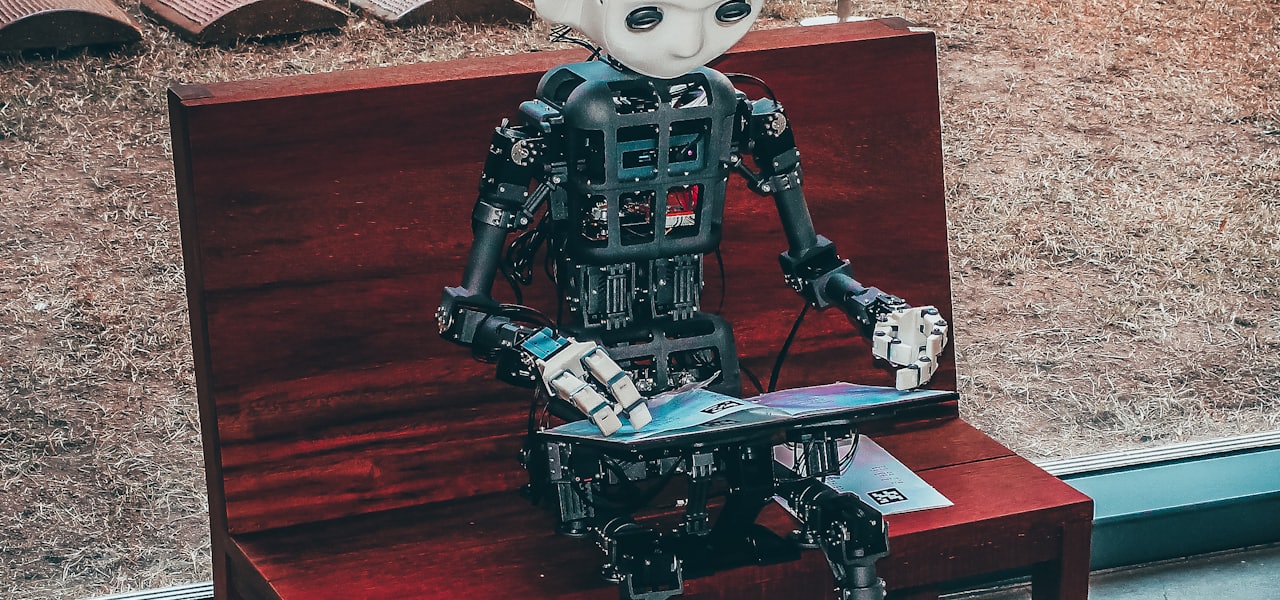
    Anthrobotics is the science of developing and studying robots that are either entirely or in some way human-like. The term anthrobotics was originally coined by Mark Rosheim in a paper entitled "Design of An Omnidirectional Arm" presented at the IEEE International Conference on Robotics and Automation, May 13–18, 1990, pp. 2162–2167. Rosheim says he derived the term from "...Anthropomorphic and Robotics to distinguish the new generation of dexterous robots from its simple industrial robot forebears." The word gained wider recognition as a result of its use in the title of Rosheim's subsequent book Robot Evolution: The Development of Anthrobotics, which focussed on facsimiles of human physical and psychological skills and attributes. However, a wider definition of the term anthrobotics has been proposed, in which the meaning is derived from anthropology rather than anthropomorphic. This usage includes robots that respond to input in a human-like fashion, rather than simply mimicking human actions, thus theoretically being able to respond more flexibly or to adapt to unforeseen circumstances. This expanded definition also encompasses robots that are situated in social environments with the ability to respond to those environments appropriately, such as insect robots, robotic pets, and the like. Anthrobotics is now taught at some universities, encouraging students not only to design and build robots for environments beyond current industrial applications, but also to speculate on the future of robotics that are embedded in the world at large, as mobile phones and computers are today. In 2016 philosopher Luis de Miranda created the Anthrobotics Cluster at the University of Edinburgh "a platform of cross-disciplinary research that seeks to investigate some of the biggest questions that will need to be answered" on the relationship between humans, robots and intelligent systems and "a think tank on the social spread of robotics, and also how automation is part of the definition of what humans have always been". to explore the symbiotic relationship between humans and automated protocols.

    Read more →
  • Software token

    Software token

    A software token (a.k.a. soft token) is a piece of a two-factor authentication security device that may be used to authorize the use of computer services. Software tokens are stored on a general-purpose electronic device such as a desktop computer, laptop, PDA, or mobile phone and can be duplicated. (Contrast hardware tokens, where the credentials are stored on a dedicated hardware device and therefore cannot be duplicated — absent physical invasion of the device) Because software tokens are something one does not physically possess, they are exposed to unique threats based on duplication of the underlying cryptographic material - for example, computer viruses and software attacks. Both hardware and software tokens are vulnerable to bot-based man-in-the-middle attacks, or to simple phishing attacks in which the one-time password provided by the token is solicited, and then supplied to the genuine website in a timely manner. Software tokens do have benefits: there is no physical token to carry, they do not contain batteries that will run out, and they are cheaper than hardware tokens. == Security architecture == There are two primary architectures for software tokens: shared secret and public-key cryptography. For a shared secret, an administrator will typically generate a configuration file for each end-user. The file will contain a username, a personal identification number, and the secret. This configuration file is given to the user. The shared secret architecture is potentially vulnerable in a number of areas. The configuration file can be compromised if it is stolen and the token is copied. With time-based software tokens, it is possible to borrow an individual's PDA or laptop, set the clock forward, and generate codes that will be valid in the future. Any software token that uses shared secrets and stores the PIN alongside the shared secret in a software client can be stolen and subjected to offline attacks. Shared secret tokens can be difficult to distribute, since each token is essentially a different piece of software. Each user must receive a copy of the secret, which can create time constraints. Some newer software tokens rely on public-key cryptography, or asymmetric cryptography. This architecture eliminates some of the traditional weaknesses of software tokens, but does not affect their primary weakness (ability to duplicate). A PIN can be stored on a remote authentication server instead of with the token client, making a stolen software token no good unless the PIN is known as well. However, in the case of a virus infection, the cryptographic material can be duplicated and then the PIN can be captured (via keylogging or similar) the next time the user authenticates. If there are attempts made to guess the PIN, it can be detected and logged on the authentication server, which can disable the token. Using asymmetric cryptography also simplifies implementation, since the token client can generate its own key pair and exchange public keys with the server.

    Read more →
  • IBM remote batch terminals

    IBM remote batch terminals

    The IBM 2780 and the IBM 3780 are devices developed by IBM for performing remote job entry (RJE) and other batch functions over telephone lines; they communicate with the mainframe via Binary Synchronous Communications (BSC or Bisync) and replaced older terminals using synchronous transmit-receive (STR). In addition, IBM has developed workstation programs for the 1130, 360/20, 2922, System/360 other than 360/20, System/370 and System/3. == 2780 Data Transmission Terminal == The 2780 Data Transmission Terminal first shipped in 1967. It consists of: A line printer similar to the IBM 1443 that can print up to 240 lines per minute (lpm), or 300 lpm using an extremely restricted character set. A card reader/punch unit, similar to an IBM 1442, that can read up to 400 cards per minute (cpm) and can punch up to 355 cpm. A line buffer that stores data received or to be transmitted over the communications line. A binary synchronous adapter which controls the flow of data over the communications line. The 2780 is capable of local (offline) card to print operation. It comes in four models: Model 1: Can read punched cards and transmit the data to a remote host computer, and can receive and print data sent by the host. Model 2: Same as Model 1 but adds the ability to punch card data received from the host. Model 3: Can only print data received from the host, but not send data to it. Model 4: Can read and punch card data, but has no printing capabilities. The 2780 uses a dedicated communication line at speeds of 1200, 2000, 2400 or 4800 bits per second. It is a half duplex device, although full duplex lines can be used with some increase in throughput. It can communicate in Transcode (a 6-bit code), 8-bit EBCDIC, or 7-bit ASCII. == 2770 Data Communication System == The 2770, announced in 1969, "was said to surpass all other IBM terminals in the variety of available input-output devices." The 2770 was developed by the IBM General Products Division (GPD) in Rochester, MN. It comes standard with a desktop terminal with keyboard. The printer and other devices (any two in any combination) can be attached to the 2772 Multi-Purpose Control unit. Possible devices include: 50 Magnetic Data Inscriber 545 Card Punch Model 3 (non-printing) or Model 4 (printing) 1017 Paper Tape Reader 1018 Paper Tape Punch 1053 Printer Model 1 1255 Magnetic Character Reader Models 1, 2 or 3 2203 Printer Model A1 or A2 2213 Printer Model 1 or 2 2265 Display Station Model 2 2502 Card Reader Model A1 or A2 5496 Data Recorder == 3780 Data Communications Terminal == In May 1972, IBM announced the IBM 3780, an enhanced version of the 2780. The 3780 was developed by IBM's Data Processing Division (DPD). There is one model, with an optional card punch. The 3780 drops Transcode support and incorporates several performance enhancements. It supports compression of blank fields in data using run-length encoding. It provides the ability to interleave data between devices, introduces double buffering, and adds support for the Wait-before-transmit ACKnowledgement (WACK) and Temporary Text Delay (TTD) Binary Synchronous control characters. The integrated punched card unit can read cards at 600 cards per minute. The integrated printer is rated at 300, 350 or 425 lines per minute based on characters set (63, 52 or 39 characters). The 3781 Card Punch is an optional feature. It punches 160 columns per second, or 91 cards per minute if all 80 columns are punched. The IBM 2780 and 3780 were later emulated on various types of equipment, including eventually the personal computer. A notable early emulation was the DN60, by Digital Equipment Corporation in the late 1970s. == 3770 Data Communications System == In 1974 IBM Data Processing Division (DPD) offered a successor to the 3780, called the 3770 Data Communications System, supporting SDLC, BSC, BSC Multi-leaving and SNA, depending on the configuration. The 3770 is a family of desk console style terminals that offers a variety of keyboard and printer combinations as well as I/O equipment attachment and communications features. The terminals come built into a desk and include the following models: 3771 Communication Terminal (optional card reader, optional card punch, wire matrix printer) Models 1 (40 cps printer), 2 (80 cps printer), and 3 (120 cps printer). 3773 Communication Terminal (diskette, wire matrix printer) Models 1 (40 cps printer), 2 (80 cps printer), and 3 (120 cps printer). Each model has a P version which adds some programming features. 3774 Communication Terminal (optional card reader, optional card punch, optional belt printer, wire matrix printer) Models 1 (80 cps printer), and 2 (120 cps printer). Each model has a P version which adds some programming features, a 480-character display and a non-removable diskette. 3775 Communication Terminal (optional card reader, optional card punch, optional diskette, belt printer) Model 1 (120 lpm printer). The model P1 adds some programming features, a 480-character display and a non-removable diskette. 3776 Communication Terminal (optional card reader, optional card punch, optional diskette, belt printer) Models 1 (300 lpm printer) and 2 (400 lpm printer). Models 3 and 4 are similar to models 1 and 2. 3777 Communication Terminal (optional card reader, optional diskette, train printer) Model 1 (up to 1000 lpm printer depending on character set). Model 2 adds an optional card punch, model 3 adds an optional magnetic tape drive and model 4 replaces the train printer with a slower model called the IBM 3262. The model 4 also allows a second, optional, 3262. The following I/O devices can be attached to a 3770 terminal: IBM 2502 Card Reader: Models A1 (up to 150 card per minute), A2 (up to 300 cards per minute) or A3 (up to 400 cards per minute) IBM 3203 Printer Model 3: 1000 LPM using 48 character set IBM 3501 Card Reader: Up to 50 cards per minute desktop unit IBM 3521 Card Punch: Up to 50 cards per minute IBM 3782 Card Attachment unit, which allows the 2502 or 3521 to be attached to any terminal except the 3777 IBM 3784 Line Printer, can be attached to a 3774 as a second printer. Up to 155 LPM with 48 characters set print belt. == Workstation programs == IBM distributes workstation programs with systems software including OS/360 Attached Support Processor (ASP) Houston Automatic Spooling Priority (HASP and HASP II) Operating System/Virtual Storage 1 (OS/VS1) Operating System/Virtual Storage 2 (OS/VS2 MVS) Release 2 through 3.8 MVS versions from MVS/SP Version 1 through z/OS Priority Output Writers, Execution processors and input Readers (POWER) Remote Spooling Communications Subsystem (RSCS) Except for the RJE workstation programs in OS/360, these programs use a variation of BSC known as Multi-leaving. In addition, IBM provides separately ordered workstation programs using BSC. Systems Network Architecture (SNA) and TCP/IP. Workstation programs are available from IBM and third-party vendors to support all of these protocols: 2770/3770 2780/3780 Multileaving Network Job Entry (NJE) OS/360 RJE SNA TCP/IP

    Read more →